Warehouse Reporting
Part of Picking technology
Measuring picking productivity without hiding errors
“Picks per hour” is tempting because it is easy to chart.
undefined
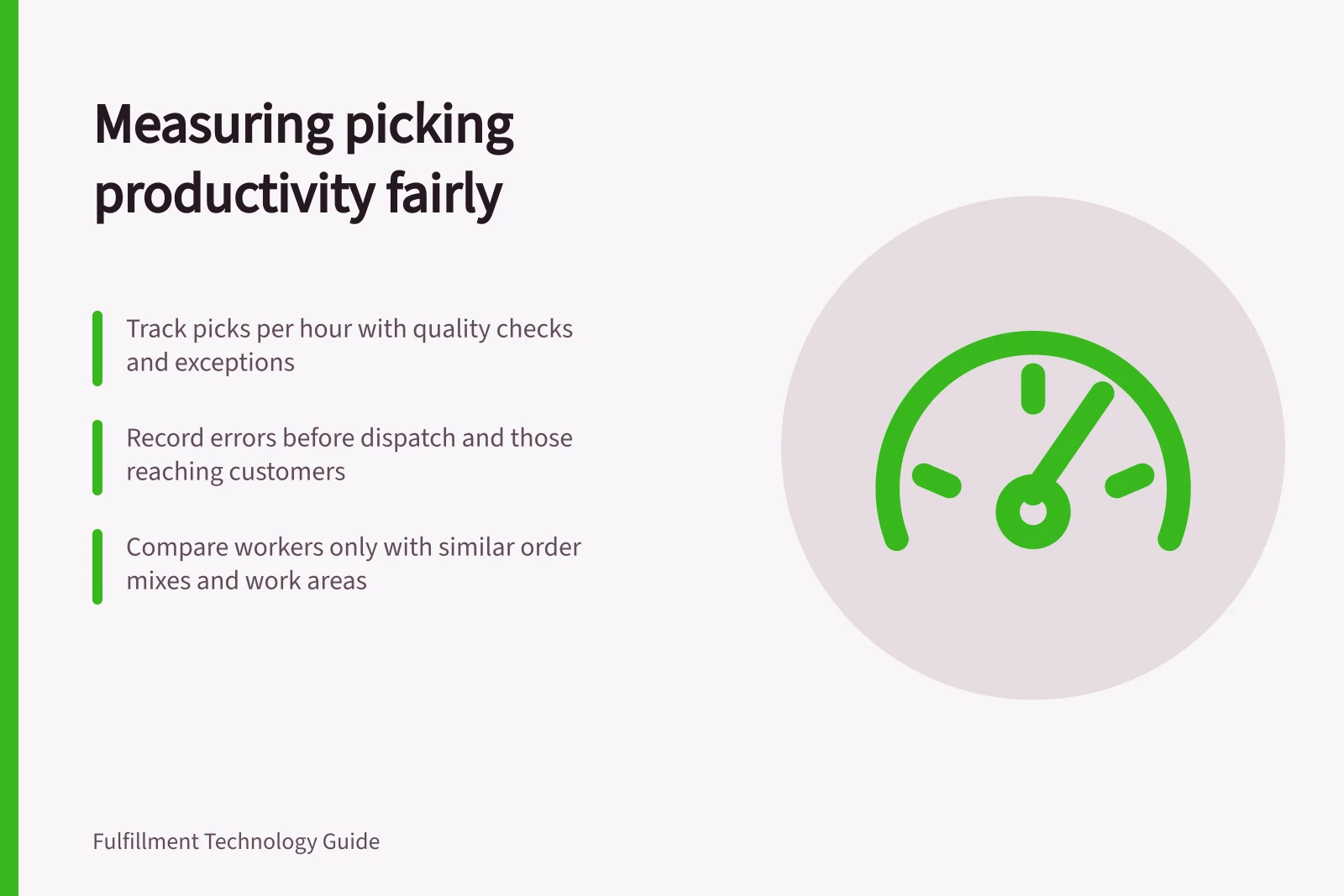
‘Picks per hour’ alone can reward a process that passes mistakes to packing. Measure picking rate, order-picking accuracy and backorder line percentage together, and keep a visible trail of exceptions from pick checks through packing and customer reports.
Define the picking unit and denominator
Choose the output unit before calculating the rate: items, cases or pallets can be counted, while the local measure may instead be order lines or completed orders. Calculate the number of picked units per hour; units might be single items, cases or pallets (Dawson Consulting).
Compare workers or methods only where the order mix and work area are similar. Batch picking can reduce repeated travel, while single-order picking avoids a later sort; compare the complete order cycle, not just a fast segment.
Keep a picking productivity report with fields for reporting period, method or work area, output unit, picked output, hours counted, orders picked, orders picked accurately and checks active. Populate throughput from a pick tally, accuracy from order-check tallies and order totals, and exceptions from a separate log; record the underlying source for each figure so it can be traced.
Track errors at each detection point
Pair throughput with order-picking accuracy: (Number of orders picked accurately / total number of orders picked) * 100 (Dawson Consulting). Record inaccurate orders caught by checkers before dispatch and confirm their correction, but keep customer-reported mistakes separate so a corrected pick does not disappear from the exception trail.
Record which checks were active in each comparison, log exception time and repeated bypasses, and review a consistent sample of completed work against source orders. Add a backorder line percentage as a separate exception measure: (Number of order lines delayed in shipment / total number of order lines processed) * 100 (Dawson Consulting). This reports delayed lines, not the stage responsible for an error.
Track wrong-item picks, short picks, scan mismatches, repicks, packing corrections and customer-reported mistakes as separate events. For each, record the order or line, where it was found, the suspected stage (picking, replenishment or packing), the check active and whether it was corrected before dispatch. Keep the detection point separate from suspected cause, leaving cause unassigned until the order trail supports an attribution.
A new verification prompt may increase recorded mismatches while reducing shipped errors, so the first count alone could make a useful control look worse. When a rate improves, check that the quality standard and workload boundary still apply before changing targets or incentives, and report the trade-off plainly.
Key Exception Tracking Metrics for Picking Quality
- Wrong-Item Picks
- Count of incorrect items picked
- Short Picks
- Lines with missing or under-picked items
- Scan Mismatches
- Discrepancies between scanned and expected items
- Packing Corrections
- Issues resolved during packing stage
- Customer-Reported Mistakes
- Errors reported post-shipment