WMS Selection
Part of Warehouse automation readiness
Choosing a warehouse process for a small automation pilot
Select a bounded warehouse automation pilot using a measurable problem, dependable inputs, observable outcomes and safe recovery.
Choose a pilot process with a measurable problem, a clear work boundary, dependable inputs and a safe way to account for unfinished work. A small trial should answer one operational question for the process and order mix tested.
List bounded candidates
Describe each candidate as a physical task and its system record. Moving identified totes from storage to one pick station is a clearer trial boundary than “automate picking”. Other candidates might be a repeated replenishment move or sorting picked units into orders.
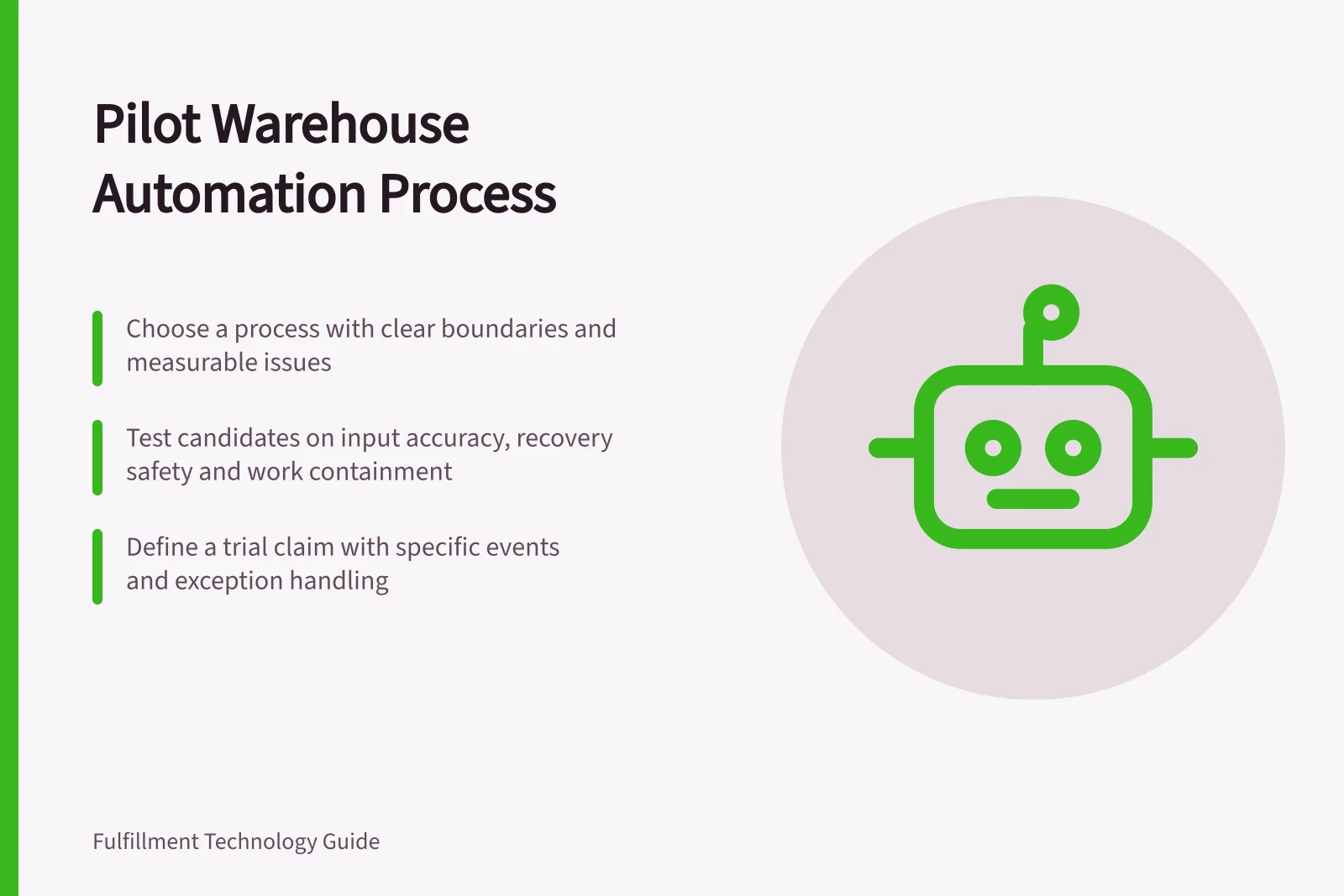
For each candidate, record current workload, waiting time, errors and staff effort. Include ordinary and busy periods, item sizes, routes and exceptions. Compare candidates on the problem they could solve, rather than the appeal of the equipment demonstration.
Apply four selection tests
| Test | Question |
|---|---|
| Boundary | Can staff tell which work enters the pilot and which stays on the existing route? |
| Inputs | Do item, unit, location and stock records match the goods involved? |
| Outcome | Can correct completed work and exception effort be compared with a baseline? |
| Recovery | Can staff stop the trial and account for goods and open instructions safely? |
Hold a candidate with unresolved identity or safety problems until those problems are addressed. A modest workload can still make a useful trial if the outcome is measurable and the work can be contained.
State the trial claim
Write a claim the trial could disprove. For example: “Moving these totes to one station will reduce picker waiting time while preserving item and location accuracy.” Define eligible orders, the starting event, the completed event and the observations needed for a continue, revise or stop decision. Include a relevant busy interval; a quiet demonstration cannot establish peak capacity.
Specify the instruction and returned result the proposed connection must handle. In Microsoft's Dynamics 365 material handling equipment interface, outgoing work events and incoming completion or short-pick events use separate queues. This illustrates why a sent instruction does not by itself establish completed work. Ask the supplier to show the states in the configuration proposed for the site.
Include exceptions that fit the task, such as a missing tote, unreadable identifier, unavailable location or interrupted instruction. Record the safe stop or correction route before work begins. These are proposed trial cases, not reported results.
Decide from the complete work
Compare the same process boundary before and during the pilot. Count correct completed units and staff time spent loading, replenishing, clearing faults and reconciling records. Check whether a queue simply moved to another stage.
Continue if the defined problem improves and goods and work records reconcile safely. Revise a real but fixable input or layout problem. Stop if the team cannot explain the physical and system outcomes. A short trial supports conclusions only about its tested mix and configuration.