Carrier Integrations
Part of Third-party fulfilment technology
Comparing integration support from fulfilment providers
Compare eStore Logistics and ShipBob on documented integration routes, change limits, recovery and account questions.
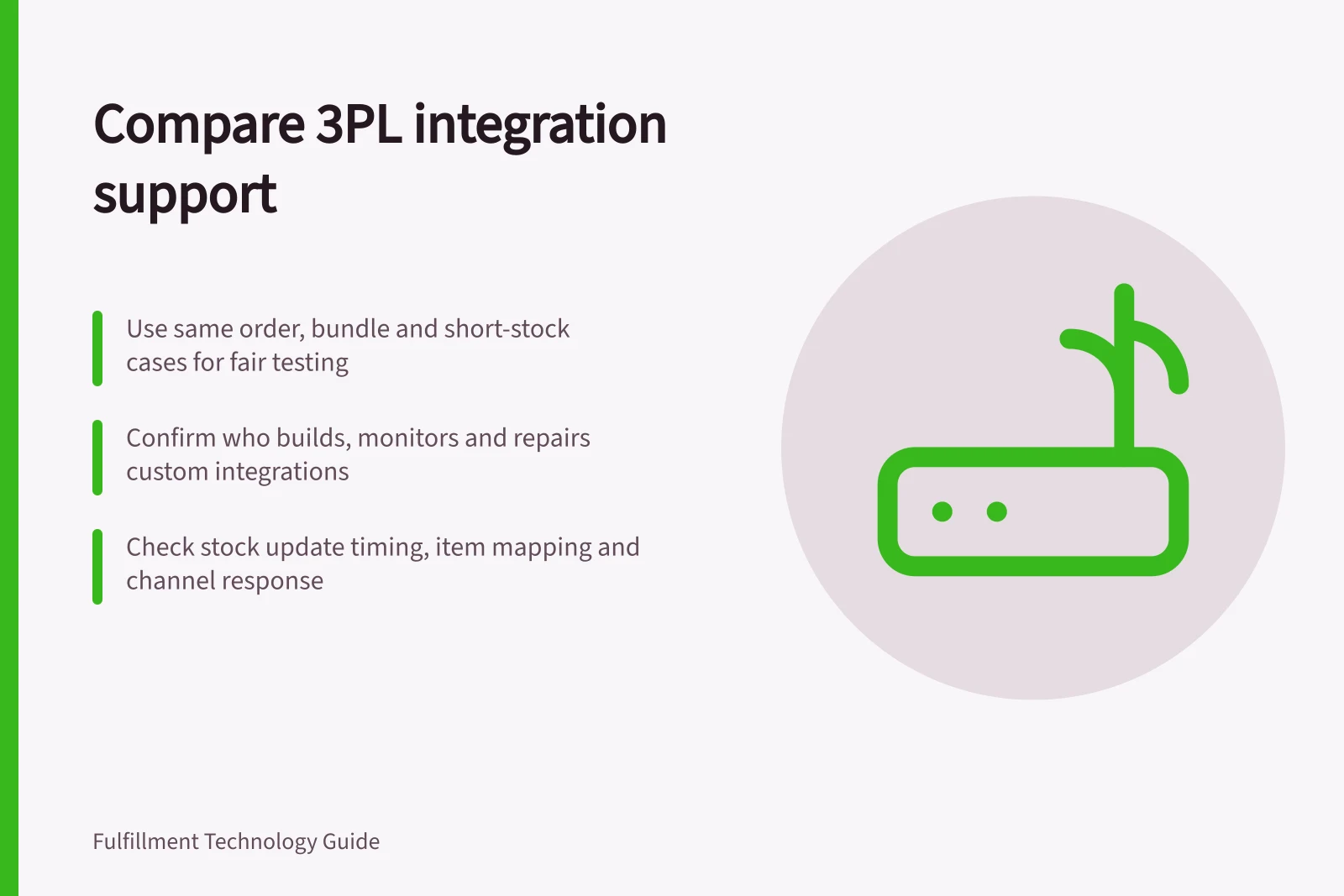
Compare 3PL integration support by following the same order, stock update and failure through each provider’s proposed route. A listed connector shows a possible starting point: it does not establish which fields travel, who maintains the connection, or how a failed message is recovered.
Set the comparison questions
Name the merchant’s sales channels, item and variant IDs, bundle rules, holds, delivery choices and required return updates. Ask each provider for the route proposed for those records.
Dimension / Evidence to request
- Route
- Connector, middleware, API or file exchange for each channel
- Order acceptance
- Provider order ID, accepted line quantities and rejection record
- Stock update
- Quantity definition, item mapping, timing and channel response
- Shipment return
- Completed lines, shipment or parcel IDs and tracking
- Change and failure
- Editing limit, retry process and responsible team
- Support and cost
- Setup owner, ongoing support and written account terms
Ask who builds, monitors and repairs custom work. An API can expose records while leaving those tasks to the merchant or its integration partner.
Proposed Integration Workflow for a Sales Order
- Order ReceivedFrom sales channel (e.g., Shopify, WooCommerce)
- Route DeterminedDirect connector (ShipBob) or middleware (eStore)
- Stock Check & UpdateInventory adjusted based on item mapping and timing; ShipBob may reassign inventory IDs during merge
- Shipment CreationShipment ID generated; tracking data returned via API (ShipBob) or exported (eStore)
- Exception HandlingEdits possible pre-warehouse work; post-work changes depend on provider limits
eStore Logistics
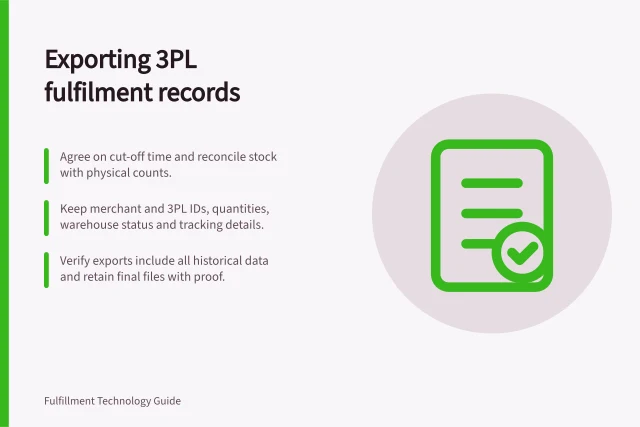
eStore’s Australian fulfilment offering includes the Express merchant platform. Its public software page describes sales-order views, tracking, inventory, inbound work, returns and an integration layer. The Express guide documents order search and selected-column Excel export. The public page does not specify the exact fields or behaviour of a connector proposed for a particular channel.
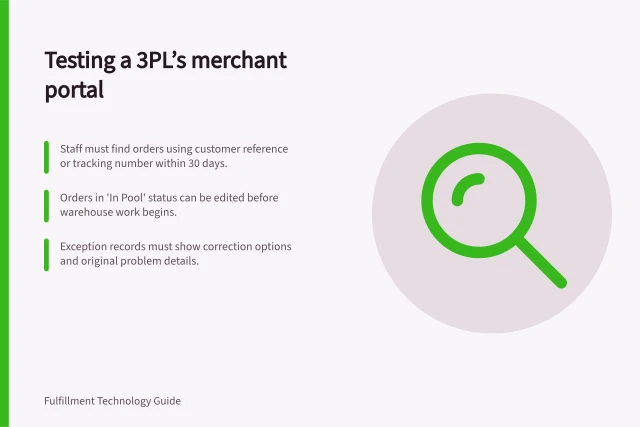
Express’s ordinary editing guide permits edits to orders in “In Pool”; its order-detail guide separately describes correction of Exception orders. Default order search covers the last 30 days, with archival search for older records.
Ask eStore to demonstrate the proposed order route, accepted quantities, stock update and support path. Obtain setup, access and cost terms in writing. Public material does not establish its developer endpoint coverage for this comparison.
Key Integration Metrics for Australian Fulfilment Providers
- eStore Logistics – Order Search Window
- Last 30 days (default); archival search available
- ShipBob – API Documentation Coverage
- Extensive (order creation, inventory, shipment handling)
- ShipBob – Australian Fulfilment Centres
- Available in Sydney and Melbourne
- eStore – Export Functionality
- Selected-column Excel export from order views
- ShipBob – Inventory ID Stability
- May change during product merge
ShipBob
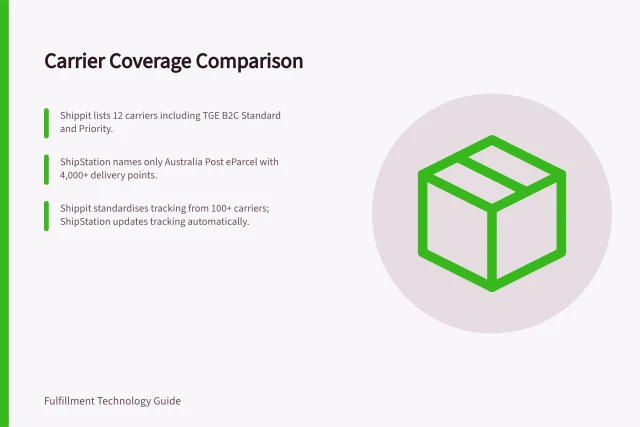
ShipBob describes Australian fulfilment centres, direct connections for platforms including Shopify, BigCommerce and WooCommerce, middleware for some orders without a direct connection, and a REST API. Its developer guide shows an order response that includes associated shipments, with shipment IDs and line items. Confirm which route and functions the proposed merchant account would use.
The developer guide sets out creating an order with a shipbob_channel_id in the request header and a reference_id for the order.
ShipBob’s inventory guide says a product merge may change a stored inventory ID. These are API limits and design considerations; a direct platform connector may expose different controls. ShipBob’s Australian locations page invites merchants to request fulfilment pricing.
Compare the same cases
Use an ordinary order, a bundle, a short-stock order and an order changed after warehouse work begins. For each provider, request the source record, provider acceptance, stock response, shipment response and recovery route. Include an uncertain response and check whether existing work can be found before another instruction is sent.
Record what was shown in the proposed configuration and what remains unverified. The choice depends on coverage of the merchant’s actual records, responsibility for the connection and whether staff can resolve exceptions without losing or duplicating work. This is a documentation-based comparison, not a ranking of live service performance.
Integration Support Comparison: eStore Logistics vs ShipBob (Australia)
- Order RouteeStore: Connector/middleware (unspecified fields); ShipBob: Direct platform connector or REST API
- Order AcceptanceeStore: Provider order ID and accepted line quantities (via Express platform); ShipBob: `shipbob_channel_id` and `reference_id` in API request
- Stock UpdateeStore: Not specified; ShipBob: Product merge may change inventory ID; timing depends on integration type
- Shipment ReturneStore: Tracking and parcel details via Excel export; ShipBob: Shipment IDs and line items returned in API response
- Change & Failure RecoveryeStore: Edits allowed in 'In Pool'; exceptions require separate correction; ShipBob: Retry process defined in API guide; responsibility unclear
- Support & CosteStore: Setup, access, and cost terms to be confirmed in writing; ShipBob: Pricing available upon request via Australian locations page