WMS Selection
Part of Fulfilment technology resilience
Testing recovery after a WMS interruption
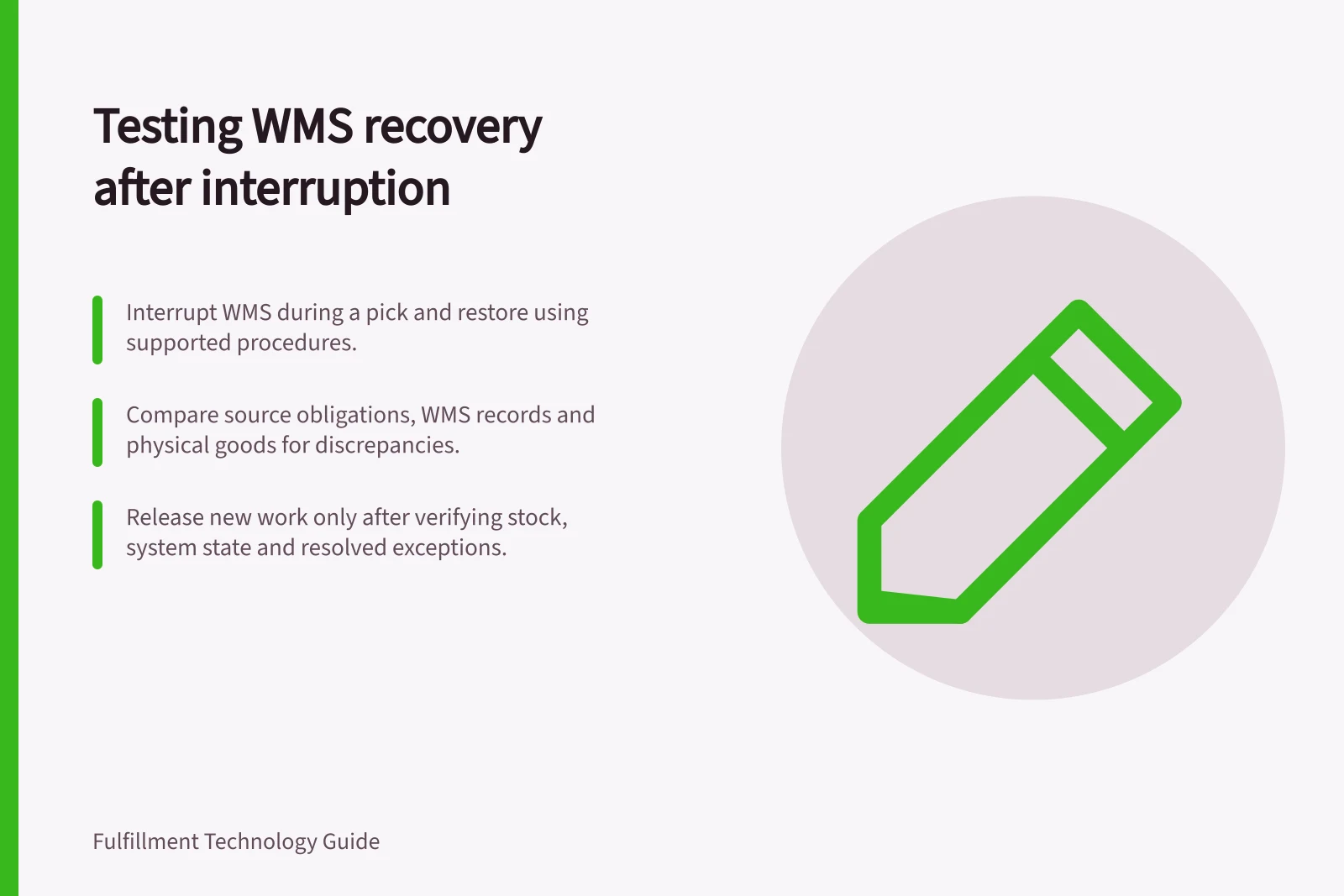
Run a controlled WMS recovery exercise that reconciles restored records with orders, stock and physical warehouse work.
Test WMS recovery by interrupting a controlled set of work, restoring the service, and reconciling each affected order line against WMS records and physical goods. A successful login after restart is one check only. The exercise ends with a documented decision on whether to release new work.
Set a safe boundary
Use an isolated test environment, or a controlled exercise window with safeguards against accidental customer dispatch. Record the WMS configuration, connected services, devices and roles involved.
Choose a reversible scenario, such as losing WMS access during a pick, or losing an acknowledgement after physical work. Any exercise involving live systems or equipment requires the site's technical and safety approval.
Write expected outcomes before starting. Give each sample order source and line IDs, assigned stock, a work reference and an expected physical position.
Include an ordinary case and one whose transaction will be uncertain at the interruption point. Include batch or serial identity only when the controlled exercise can account for those units.
Capture the interruption point
Stop new releases at the chosen point. Record the last confirmed WMS response, work displayed on devices, and physical goods at storage, picking, packing and parcel positions.
Log any later permitted action separately with its operator, time, item, quantity and location. Keep uncertain device messages marked as uncertain until the WMS record is checked.
Record the selected restore point and the work that followed; that gap is where missing or duplicate transactions can arise.
Compare three views
Restore through the installed WMS's supported procedure and confirm the required identity, network and integrations are available. Compare:
- Source obligations:original order lines, quantities, holds and changes.
- WMS records:instructions, completed work, stock positions and exceptions.
- Physical position:goods in storage, picked units, packed parcels and any confirmed handover.
For each disagreement, find the original instruction and the last confirmed event. Check for an existing completion before entering one or releasing another pick.
Where goods moved but the WMS lacks the movement, use its supported correction route and retain the exercise record. An unexplained balancing adjustment does not demonstrate recovery.
Three Views for WMS Recovery Reconciliation
- Source ObligationsOriginal order lines, quantities, holds, and changes from the order system.
- WMS RecordsInstructions issued, completed work, stock positions, and exceptions logged in the WMS.
- Physical PositionActual location of goods in storage, picked units, packed parcels, and confirmed handovers.
Decide whether to release work
Set acceptance conditions before reviewing results. Each tested line should have an explained outcome, stock used for the test should agree with its observed physical position, connected systems should show the intended state, and unresolved exceptions should have owners.
Record the time taken and any data gap against the site's own targets. One exercise does not guarantee the same result in a real incident.
Release a small new-work sample and inspect its downstream acknowledgement. Hold affected work if an earlier instruction reappears, a completion arrives late or a parcel state remains uncertain.
Save the inputs, observed records, differences, corrections and decision to retest. Update the procedure when the exercise exposes a missing dependency.
Key Metrics to Track During Recovery Test
- Time to restore WMS
- Measured in minutes
- Data gap size
- Number of unmatched or missing transactions
- Stock reconciliation accuracy
- Percentage match between physical and recorded stock
- Unresolved exceptions
- Count of open issues with assigned owners