WMS Selection
Part of Fulfilment technology for ecommerce operations
WMS, OMS and shipping software compared
Compare the jobs of an OMS, WMS and shipping platform, then test where order, stock and shipment ownership passes between them.
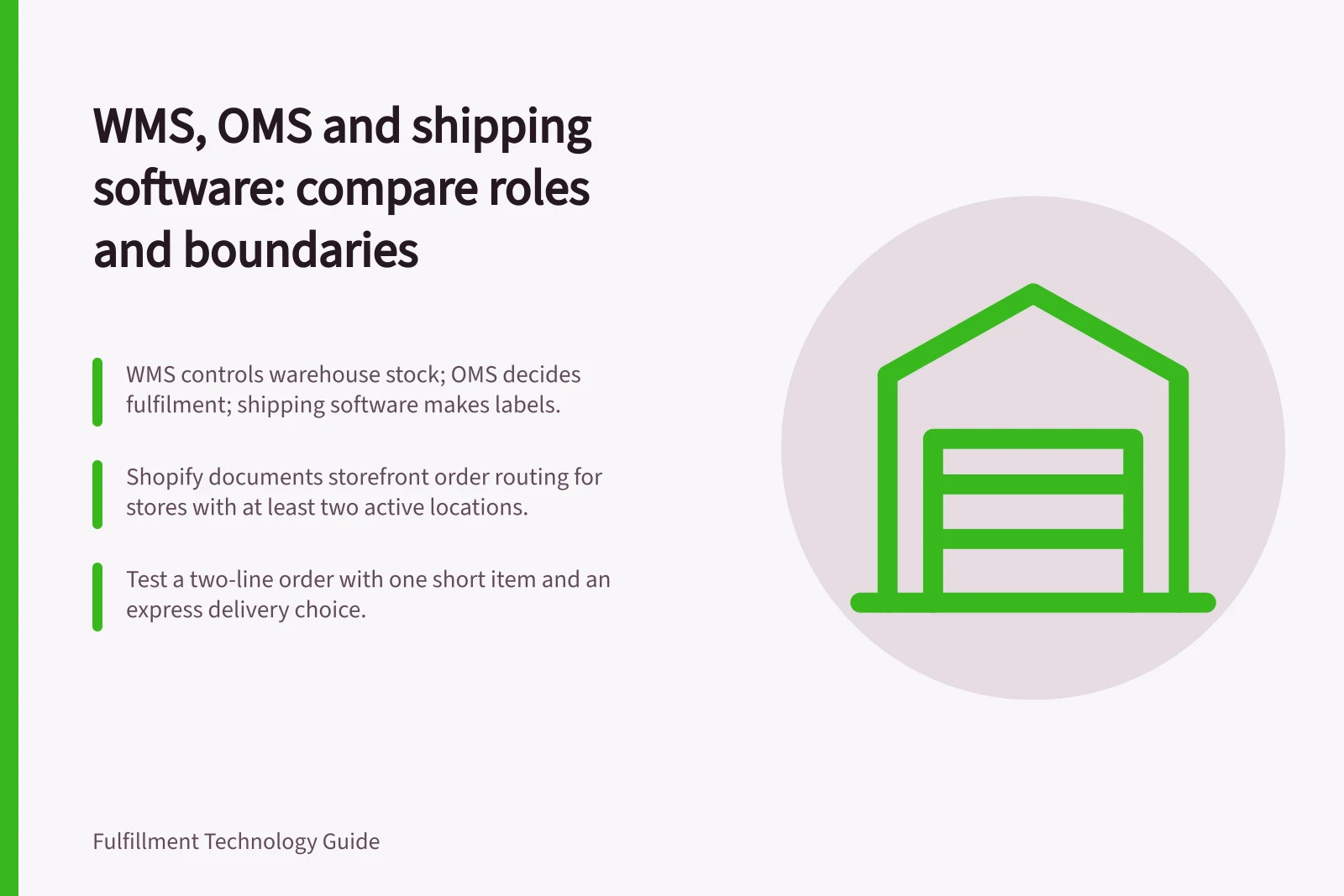
A WMS controls warehouse stock and work; an OMS manages order decisions on the way to fulfilment; shipping software prepares shipments and labels. Products can cover parts of more than one role. Compare which decisions and records each system owns before deciding whether separate tools are needed.
Compare the operating jobs
| System role | Main question | Records to inspect | Boundary to test |
|---|---|---|---|
| OMS | Which location or partner should fulfil each order line? | Order, allocation, hold and fulfilment state | Can a change or shortage reach the warehouse without losing the order decision? |
| WMS | Where is the stock, and what should a worker do next? | Item, location, stock status and warehouse work | Does completed work return the correct quantity and exceptions to the order owner? |
| Shipping software | Which eligible service should carry this parcel? | Packed parcel, service, label and tracking ID | Does label creation update the right shipment without being mistaken for carrier handover? |
Microsoft's Intelligent Order Management illustrates order orchestration and fulfilment visibility. Its Supply Chain Management warehouse module illustrates receiving, picking, counting and packing. ShipStation illustrates shipping automation. These are product examples, not universal definitions or a tested comparison.
WMS, OMS and shipping software: job, records and boundary
- OMSMain question: which location or partner should fulfil each order line? Records to inspect: order, allocation, hold and fulfilment state. Boundary to test: can a change or shortage reach the warehouse without losing the order decision?
- WMSMain question: where is the stock, and what should a worker do next? Records to inspect: item, location, stock status and warehouse work. Boundary to test: does completed work return the correct quantity and exceptions to the order owner?
- Shipping softwareMain question: which eligible service should carry this parcel? Records to inspect: packed parcel, service, label and tracking ID. Boundary to test: does label creation update the right shipment without being mistaken for carrier handover?
Identify overlapping ownership
A storefront may already route orders among locations; Shopify documents this for stores with at least two active locations. That may meet a simple allocation need, but it does not establish how detailed warehouse work or cross-system exceptions are handled.
A WMS may also print labels, while shipping software may store a ship-from location. Check the hand-off, not just the presence of a feature.
Choose an authoritative owner for each decision. If an OMS allocates stock, define when that allocation is released or cancelled. If a WMS controls pickable quantity, define when the OMS receives shortages and completions. If shipping software creates a label, state who may void, replace or reprint it.
Multiple systems changing the same state without a clear rule can leave contradictory records.
Product boundaries also vary by market and plan. An Australian buyer should verify the available functions in the proposed account rather than infer them from a generic feature list.
Test one boundary case
Use a two-line order with one short item and an express delivery choice. Ask each supplier to show:
- The location and quantity allocated to each line, including the short line.
- The warehouse task and the worker's shortage response.
- The packed parcel data used to choose an eligible service.
- The shipment and tracking identifiers returned to the order record.
- The states left behind if the label request fails or the order changes.
Record which application owns each step, how updates move between systems and where staff must re-enter data. This produces a boundary map, not a brand score.
A smaller operation may manage with a storefront and shipping software. More complex allocation may call for order orchestration; detailed location and worker controls may call for a WMS. Treat those as hypotheses until the order profile and exception path show what is required.
The two-line boundary test to run with each supplier
- Allocation shownThe location and quantity allocated to each line, including the short line.
- Warehouse task and shortage responseThe warehouse task created, and how a worker records a shortage against it.
- Parcel data for service choiceThe packed parcel data used to choose an eligible service.
- Identifiers returnedThe shipment and tracking identifiers returned to the order record.
- State after failureThe states left behind if the label request fails or the order changes.